
This post may contain affiliate links. At no cost to you, I will receive a small commission from sales made through these links.
Situated on the southern banks of the Loire River lies the charming medieval town of Amboise. Close enough to Paris for a day trip, visiting Amboise will allow you to see some of the Châteaux that France is known for.
It’s a great base to see the Loire River Valley without the need to rent a car or get on a tour bus.
getting to amboise
You can easily do this itinerary in a day and see the Royal Château d’Amboise, Château le Clos Lucé, and Château Gaillard. The train from Paris leaves about every twenty minutes, and there is service between Paris and Amboise ~30 times per day.
We took an early train, 8:35am, which put us in Amboise at about 10:40 in the morning. Amboise isn’t the shortest day trip, but it’s the most memorable one I’ve had from Paris thus far.
Want $40 off your first Airbnb rental? Click here!
train through the French countryside
The average train journey is 2.5 hours and is roughly 15 euro per person, one way. Grab a croissant at the train station, hop on, and enjoy the scenic ride through the French countryside.
Upon arrival at Amboise station, it’s roughly a fifteen-to-twenty minute walk across the Loire into the town center. The first château I visited was Royal Château d’Amboise, which sits directly on the banks of the Loire.
royal château d’amboise - a history
Since Neolithic times, castle residents have used the upper area of the castle as an observation post for the meeting of the Loire and its tributary. Standing at about 40m tall, this vantage point offered a leg up when it came to defense.
In 1431, Louis of Amboise was condemned to death for plotting against a favorite of King Charles VII, Le Trémoille. The crown eventually acquitted Louis of Amboise, yet he was still forced to abdicate the Château. The crown eventually seized the castle.
kings’ residence in the Loire Valley
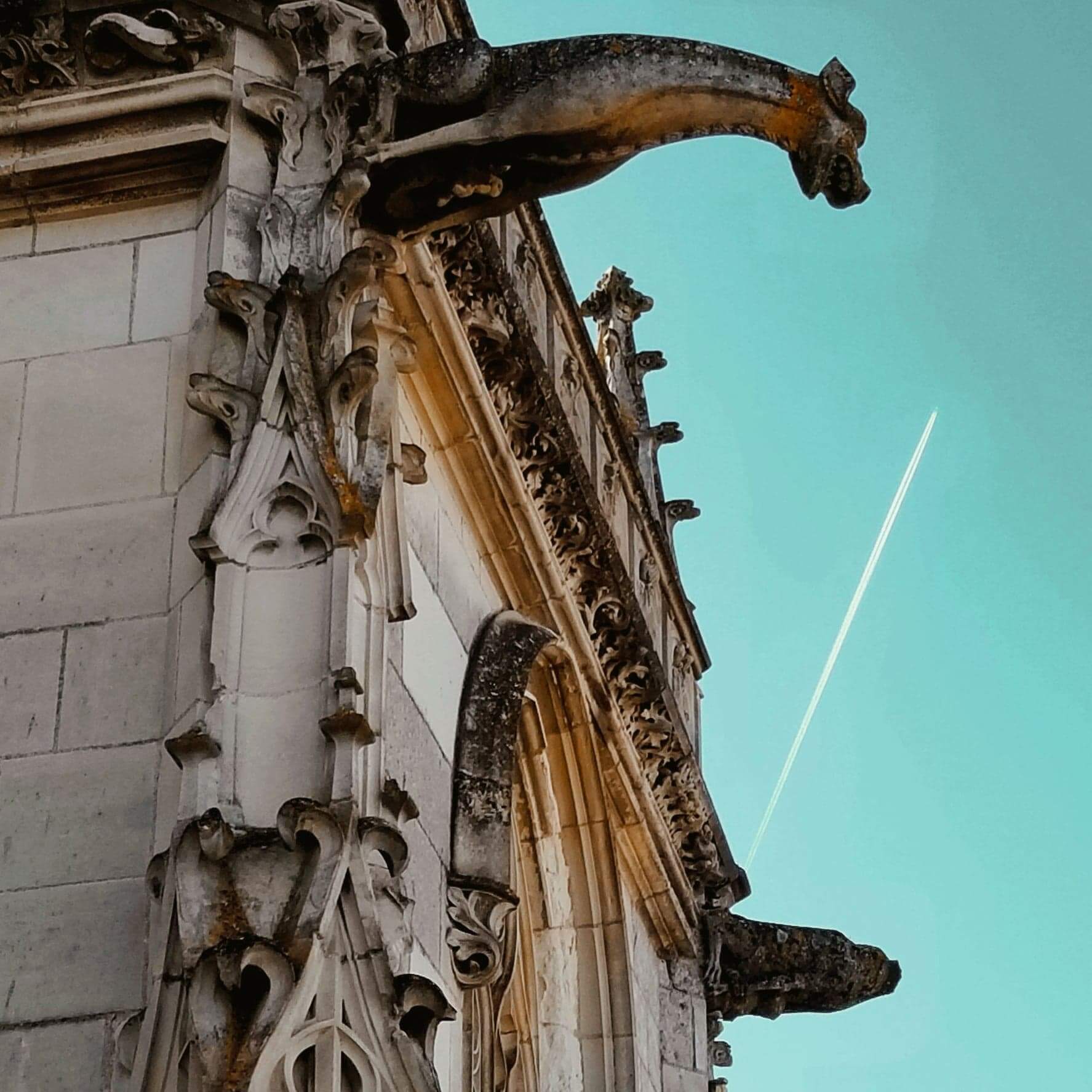
The 15th century marked the beginning of the French kings’ residence in the Loire Valley. The reign of Charles VIII led to the transformation of the bygone medieval bastion into a lavish Gothic palace. He also ordered the construction of the two ceremonial loggias and a chapel on the site of the oratory built by his father.
When Charles VIII returned from the Italian campaign, he enlisted many Italian artisans to help work on the Château.
influential Italians
When Charles VIII died at 28 with no heir, his cousin, Louis XII, succeeded him. Louis XII married the dead king’s widow, Anne of Brittany. Louis XII continued building projects begun by his predecessors before passing the tradition to his son, François Ier. François Ier continued to enhance the Château in the Italian style.
François Ier’s son, Henri II, continued to embellish the Château with his wife, Catherine de Medici. Their three sons successively held the French throne. Under their reigns, royal visits to the Château became less frequent. Eventually, Amboise stopped holding the seat of the French court.
Royal Château d’Amboise today
At the end of the 16th century, Amboise reestablished its purpose as a bastion because of its location. The French Kings used it as a lodging for during their travels around the kingdom.
Then, the French Revolution definitively changed the fate of the Château. In 1793, the authorities seized the Château and its contents.
The primary purpose was to turn it into a barracks for veterans from campaigns led by the revolutionary armies. Eventually it became the museum it is today.
death of ldv
Per his request, When LDV died in May 1519, he was buried in the church of Saint-Florentin. The church was part of the Royal Château d’Amboise, but the Revolution saw its destruction.
Roughly 50 years later, excavators discovered a skeleton at the church site. Scattered nearby were some inscribed stones etched with Leonardo da Vinci’s name. The remains were then moved to la Chapelle Saint-Hubert, pictured above.
town of amboise
Continuing on to Château le Clos Lucé, half-timbered and stone housing line the narrow streets of Amboise.
The stone buildings are Renaissance style built of a local type of stone whose color fades over time. The half-timbered houses date all the way back to the Middle Ages. Both lend a certain charm and old-feel to the town that you don’t get in Paris.
Despite it being a chilly day in early April, the town was beginning to feel alive. People began emerging from their hibernations and reenter the world of the living. It all cemented my belief that Amboise was a perfect day trip.
There didn’t seem to be too many tourists, which was a welcome change from the overflowing streets of Paris.
le clos luce
In 1516, Francois I invited LDV to live at le Clos Lucé, where he paid him 700 gold ecus a year and financed his art. He requested in return the pleasure of hearing him speak, which he indulged in every day.
The Château itself was built in 1471 on 12th century Gallo-Roman foundations. The elegant facade of pink brick and tufa stone bears the architectural mark of the 15th century.
While, in comparison to other Châteaux, it’s not the most impressive in size nor scale, it is truly a beautiful building.
LDV remained at le Clos Lucé for the last 3 years of his life. His last years were spent painting and working on his many inventions and other endeavors.
Both jack and master of all trades, Leonardo was an engineer, an architect, a producer. He organized marvelous celebrations for the court. He had grand plans to connect the Loire Valley with the Lyon region by a system of canals. LDV provoked both thought and fashion around him.
ldv’s workshop
His workshop consisted of three different areas - one each for painting, sculpting, and designing. The design studio is where one could find the double helix staircase, sketches for inventions, and the engineer’s model.
He had a naturalist cabinet, a personal library, manuscripts and codices astrolabes, world maps, measuring tools, fossils, herbariums, among others.
In his workshops, Leonardo da Vinci worked endlessly on major royal commissions. He served as a painter, engineer, architect, sculptor, and scenographer for marvelous festivities.
He worked up until his last breath finalizing his three favorite masterpieces - The Mona Lisa, The Virgin and Child with Saint Anne and Saint John the Baptist.
ldv inventions
Upon entering the basement, you’re introduced to Leonardo the engineer. The rooms downstairs are devoted to the inventions of Leonardo da Vinci. Over 40 machines, each light years ahead of their time, were produced from IBM using LDV’s original drawings and using materials of the period.
LDV invented things in the fields of civil engineering, mechanics, optics, military engineering, hydraulics, and aeronautics. The first tank, the first automobile, the swing bridge, the paddle boat, the flying machine, the helicopter, and the parachute were all among LDV’s creations.
ldv in nature
On the Château grounds there lies the LDV park. Leonardo derived all of his ideas from observing nature. The park highlights LDV’s sources of inspiration, leading from the observation of natural phenomena to his inventions.
The park is arranged into 6 themes in order to help visitors understand the multidisciplinary genius of the master himself.
If you’re hungry while you’re here there is a crêperie and tearoom, a snack shop, and a restaurant boasting the original recipes from the time of LDV. I didn’t try any of these places and instead found a restaurant in town to eat in. I can’t attest to the quality or lack thereof, but I do know that these places cater EXCLUSIVELY to tourists, and so prices are likely very inflated to reflect that.
Château le Clos Lucé was what I was most excited for in Amboise, primarily for the history and the connection to Leonardo da Vinci, and it did not disappoint.
The basement containing the inventions had framed quotes from da Vinci, many inspiring, many just simply so profound. There were many chill-inducing moments during my visit.
hours & tickets
The only days Château le Clos Lucé are January 1st and December 25 and rates vary between 13,50 and 16,00 depending on the season for an adult ticket. Children and student prices are less expensive and large families can buy group tickets, all of which can be purchased online or in person.
walk to the next castle
The walk from Château le Clos Lucé to Château Gaillard was the longest portion of the trek. This itinerary consists of a lot of walking, and this is the longest leg of the journey.
Be sure you’re wearing comfortable shoes! I cannot emphasize this enough - I was NOT wearing comfortable shoes, and paid the price.
They’re super comfy, waterproof, and I can hike in them for 10 easy hours with no complaining, no blisters, no swollen feet. Not to mention the fact that they’re not so ugly and obtrusive that you can’t feel fashionable in them.
For someone like me, whose feet seem to be comfortable in NO SHOES, these are a solid find.
aaaaand, keep walking….
The walk was lovely, the air was crisp and clean, and the slight uphill slope generated enough heat to combat the cold of early Spring. As Château Gaillard is further outside of the center of town, the streets get quieter and the tourists are fewer and farther between.
Having spent a lot of time in Paris over the course of the past ten years, this was my first time outside of the city, and I admit, I spent a little while kicking myself for not having gone to the countryside sooner before I reminded myself that I’m a yogi and my mindfulness practice kicked in.
The longer I spent focusing on the times I’d missed in the countryside were causing me to do precisely that - miss out on the countryside. So I returned my attention to the sights and smells and sounds that surrounded the last of the walk to the Château.
Just on the outskirts of the Château grounds there is a small shop supplying local artisan confiture, marmalade and honey. A lone young woman reading a book sat behind a table with a cash register set upon it in this small cave, looking up at us with a sweet smile as we walked in to peruse the offerings.
We bought a few jams to take home, to remember the taste of France, and continued on to the castle.
l’orangerie
Château Gaillard is where the first Renaissance gardens were planted in France. Dom Pacello, who was a Benedictine botanist monk, was the master gardener behind the Jardins du Roi at Château Gaillard.
The French kings of the time dreamed of recapturing the captivating gardens of Italy, and Dom Pacello reproduced them at Château Gaillard, filling floors and terraces with orange trees.
Dom Pacello was Master Gardener to three kings of France, whose contemporary creations in the art of gardening made an enduring impact on the Loire Valley.
There are 160 trees in the orangerie, all between 10 and 100 years old, and they come in 60 varieties (Buddha’s hand, red lemon, kaffir lime, Moro blood-orange trees, finger lime, lumia, orange trees, etc.).
chateau gaillard
Château Gaillard was the most underwhelming, although the gardens were only just beginning to bloom. The orangerie was certainly the best part (not to mention eating the jams when we returned home!) - the sweet, soft aroma of the different varieties of citrus wafting along the brisk April breezes helped to ease the tension in my body I’d been holding due to the cold weather.
post chateaux
After all of that walking, you must be ready for some food, a drink, or both - in my case, it was both. Walking back toward the river, we stopped at La Réserve for a glass of rosé and a warming bowl of soupe à l’oignon, the perfect midday snack. This is where we went for lunch, although there are many other restaurants along the main road. The onion soup here was delicious (as was the rosé)!
If you manage your time a little differently and spend less time at each Château, the most visit-worthy spots in town are the town hall and the clock tower. The clock tower was built in the 15th century when it was the main entryway into town. In 1445 it became a bell tower, and a little later the clock was added.
The frequent trains between Amboise and Paris enabled us to return to the city in time for dinner, around 20:00, exhausted after a long day of walking.
There’s no denying that a day spent in Amboise will leave you with the feeling of life on the French court throughout centuries and bring you back to the Renaissance days, where art and creative forces ruled and innovative, life-changing ideas were born on a daily basis.
The escape from the city can give you a glimpse into the life of a French royal, when one may have needed to escape to this magical Loire landscape from the hustle and bustle of Parisian life.
Looking for other day trips to take from Paris? Rouen is a quaint town in Normandy famed for the execution of Joan of Arc and its gorgeous cathedral. Reims lies in the Champagne region (hello, wine tastings!) and is the city where Germany surrendered in WWII.
Leave a Reply