
This post may contain affiliate links. At no cost to you, I will receive a small commission from sales made through these links.
musée de la reddition
In an unassuming brick school building in Reims, France, sits the Musée de la Reddition. In this building, the Allied forces put an end to WWII by obtaining the capitulation of the armies of land, sea, and air of the Third Reich.
This seemingly ordinary brick building was my favorite stop in the entirety of that trip. I had created my schedule, itinerary and planned stops. I knew what the museum boasted and what I would likely find there. A collection of relics that put into perspective the months leading up to the unconditional surrender of Germany. I’d also anticipated learning a great deal about the history of both the war and Reims’ role in the war. And both of these were true - I did learn, I did see what I’d expected to see.
What I could not have expected was the overwhelming emotion that came over me, remaining long after I’d left the building. Long after I’d left the country, really.
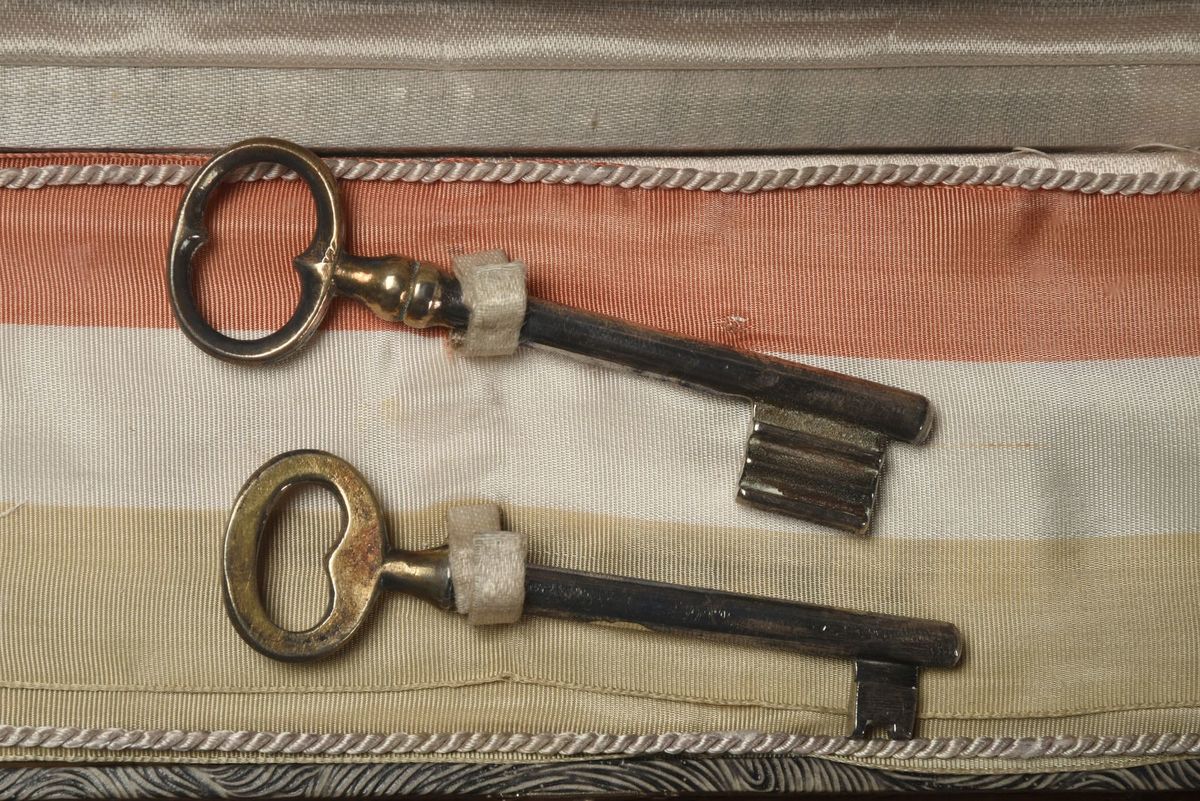
On July 7, 1945, the American General Lord officially handed these keys to the mayor of Reims, adding that they were also, symbolically, “those of the free world.”
1st impressions
A gentle-looking man with glasses greeted me upon entrance. He took payment and softly asked in which language I would like to view the film. He ushered my mother and I into a closet-sized theatre - thankfully we were the only two in the building.
We viewed a short film to set the context for the end of the war and the role the city of Reims played in the Nazi surrender. The film evoked the numerous militant groups present in Reims at the time. There was some original footage, as well as personal, harrowing accounts of peoples’ experiences during the war.
Father Peugniez, priest of the village and finder of the discovery, recovered this drift and hid it behind the organs of his church so that it didn’t fall into enemy hands.
By the time the fifteen-minute film was over, I’d noticed that I had tears streaming down my cheeks. I wasn’t sobbing… I was barely even crying. But the tears wouldn’t stop. I noticed my mom’s cheeks also stained with tears.
As I exited the theatre, the man who’d sold us the tickets said quietly, “It’s a lot, isn’t it?” I silently nodded and wondered how much emotion he saw from the people exiting that theatre on a daily basis.
into the museum
By the door at the entrance is the Headquarters’ typewritten daily bulletin, displaying casualties and injuries. Tens of thousands killed, hundreds of thousands injured or missing. Continuing through the museum, back-lit glass cases lined each room displaying uniforms, press reports, weapons parts, and artifacts from the conflict.
The exhibits spanned from the Occupation to the Liberation, through the Resistance. They enabled visitors to relive that night that forever changed the course of history of the modern world.
The signing of surrender took place secretly, in the headquarters of the Allied Expeditionary Force in Europe. General Eisenhower was the commander of the AEF.
The map room, where the signature took place, has been preserved as it was at the time. Glass panels separate the viewing area from the walls covered in war maps and statistics. In the center of the room sits the simple school table at which the generals and admirals sat to sign.
1st surrender
There is sometimes dispute as to when (and where) the surrender of Germany actually took place. This is due largely in part to the fact that there were two surrender ceremonies.
The first ceremony took place in Reims, the second in Berlin. Initially, Eisenhower insisted on “immediate, simultaneous and unconditional surrender” on all fronts. Admiral Karl Dönitz, head of state after Hitler’s suicide, dispatched General Jodl to Reims in order to convince Eisenhower to do otherwise.
However, Eisenhower quickly curtailed any discussion by declaring that, in the absence of complete and total surrender, he would resume the bombing offensive against remaining German-held cities and towns. Jodl relayed this message to Dönitz, who then authorized Jodl to sign the instrument of unconditional surrender.
This was subject to negotiating a 48-hour delay, seemingly to ensure the communication of the surrender to outlying German military units.
And so, General Jodl signed the first instrument of surrender in Reims at 02:41 on 7 May 1945. Six hours later, the Soviet High Command sent a response stating that this act of surrender was not acceptable.
This was due in part to some discrepancies in the verbage not previously agreed upon, as well as the fact that General Ivan Susloparov (who signed on behalf of the Soviet High Command) was not empowered to sign.
The Soviets argued that the ceremony shouldn’t be held on liberated territory that had been victimized by German aggression, but at the seat of government from where that German aggression sprang: Berlin.
2nd surrender
The Soviets brought up another point - while the terms of surrender required Germans to cease all military activities, they weren’t explicitly ordered to lie down their weapons and give themselves up.
Eisenhower agreed, and acknowledged that the Reims surrender was to be considered a ‘brief instrument of unconditional military surrender.’ The Berlin surrender took place just before 01:00 on 9 May, 1945. Newspapers announced German defeat simultaneously in the Allied capitals on 8 May, 1945 at 15:00.
after effects
An hour after leaving the museum, sitting in a bustling square for lunch, I could still feel the lingering tears. The sheer enormity of feeling had blown me away. It’s a strange thing, to feel emotions so strongly for others, people you haven’t ever met. Who perhaps lived in a different time, in a different world. To fully absorb the humanity of strangers.
With travel comes the opportunity to challenge the things you have always known and examine, maybe for the very first time, some hard truths. About yourself, about the world, about your perception of the world.
Travel, for me, isn’t always about seeking adventure. More often than not, it’s about seeking understanding, knowledge. Understanding of how such atrocities can occur, of how people can be driven to such hate.
You can’t change the core of your being, but you can change how you show up in the world. Start by showing up a little kinder, a little gentler. Maybe with just *thismuch* more empathy. And the world will affected by your growth. It will follow you on each step of your journey, unable to itself remain unchanged.
The map room is now classified as a Historic Monument. Preserved in its original state, it remains an indelible part of the history of Reims. The room signifies the end of a tragedy, as well as the beginning of a long period of reconciliation.
practical info
Click here for prices, hours, and holidays
He was President for 23 days, until his arrest and the dissolution of the Flensburg government on May 23, 1945. On the night of May 6, 1945, he sent a cable to Reims authorizing General Alfred Jodl, head of the German delegation, to sign the unconditional surrender of the III Reich.
Dönitz authenticated this copy on 15 April 1977, mentioning in particular “This document was signed on my order by General Jodl.”
Looking for other things to do in Reims? Reims is also known for being home to some of the world famous Champagne houses - check out a champagne tasting!
Other day trips from Paris? Rouen is a city in Normandy that is famed for being the location of Joan of Arc’s execution as well as a gorgeous cathedral. Amboise is a charming town in the Loire River Valley that boasts some amazing castles.
Need an AirBnb? Click here for $40 off your first rental!
tourist hot-spots around the world & where to go instead – the migrant yogi
[…] and it far-exceeded my expectations. Reims has quite a bit of history - it was the city where Germany officially surrendered to the Allies, ending WWII. The Musée de la Reddition is housed in the actual building […]