
This post may contain affiliate links. At no cost to you, I will receive a small commission from sales made through these links.
What do you think of when you hear ‘champagne’? New Years Eve? Elegance? Status? Champagne has long been one of my favorite libations. So, if you’re in Paris, head out on a day trip to do a champagne tasting in Reims!
I love the varying degrees of effervescence experienced with different vintages or bottles produced by different Champagne houses.
Did you know that in order for a sparkling wine to be called ‘champagne’ it has to be produced in the Champagne region of France?
the region
The Champagne region was initially a producer of still wine and provided Paris with a lot of their finest creations. Located under an hour by train from Paris, this area makes for an easy day trip.
There has been an upswing in tourism since 2015, when UNESCO designated the entire region a World Heritage site. The most popular destinations in the area are Reims and Epernay, both of which boast some of the world’s most elite wine producers.
When researching for this day trip, I knew I wasn’t going to be spending the night, so I’d have to choose between the two in order to have a substantial amount of sight-seeing time in addition to the Champagne tour.
I opted for Reims due to some of its other attractions, such as the Musée de la Reddition, Notre Dame of Reims and the Abbey of Saint-Remi.
the méthode champenoise
Despite what you may have heard, Dom Perignon didn’t invent the process of making champagne. He did make many contributions, however. Invented by Benedictine Monks, the oldest effervescent wine was created in the early 1500’s.
The creation of sparkling wine was sheer accident! It happened when someone bottled the wine prior to the end of its initial fermentation. Six years before Dom Perignon was to enter the Abbey of Hautvillers, an English scientist beat him to the punch. The man had documented the addition of sugar to a finished wine to create a second fermentation.
The méthode champenoise, as it is now referred to, involves two cycles of fermentation - once before bottling and once after. The second fermentation is what produces carbon dioxide and ethanol, two essential components of champagne.
Champagne grapes must grow in the Champagne region of France (which is why sparkling wines produced elsewhere cannot be called Champagne). Other Champagne appellation laws involve specific vineyard practices, using specific grape-pressing regimes unique to the region.
the taittinger house
After doing a little research, I decided to tour the Taittinger house. I only opted to do one tour, but it would have been nice to see some of the other houses. How their production varies, and how different their cellars are.
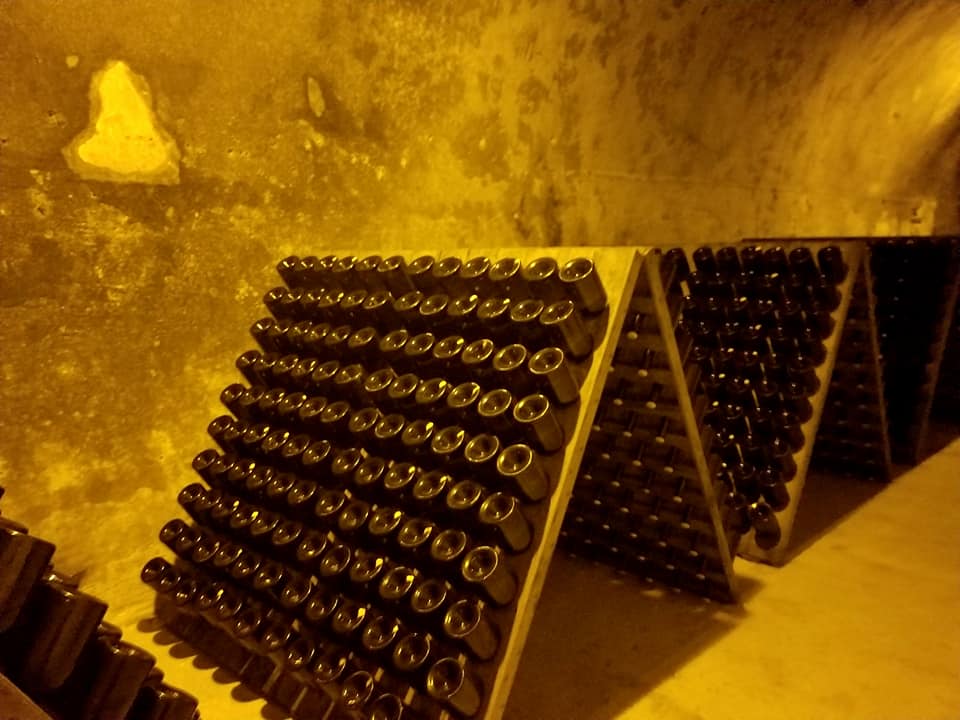
Ultimately, I chose Taittinger in particular because of the 4th century Gallo-Roman chalk mines (aka crayères). In the 13th century the crayères became the cellars of the Saint-Nicaise Abbey.
The mines are also a UNESCO World Heritage site and were originally sources of extracted chalk blocks. The Abbey was demolished during the French Revolution, but you can still see bits and pieces of her just under the earth. To get to the cellars, you have to descend 18 meters (just under 60 feet). Consider this fair warning if you get anxiety in spaces such as this!
Champagne Taittinger became a producer of sparkling wine in 1932. They created an innovative style influenced by Chardonnay, one of the three primary grapes used in the production of champagne. The Chardonnay definitely lends elegance and freshness to the glass.
Today, Champagne Taittinger boasts a 288 hectare vineyard that covers 34 different crus - this covers about 50% of their grape needs. They complement the supply with the purchase of grapes or wines carefully selected and obtained through long-term contracts with independent winemakers and several cooperatives.
In 1932, the site of the Saint-Nicaise hill became the seat of Champagne Taittinger. To go 18 meters underground is to relive the 18 centuries of history that have seen this place.
It is to encounter the spirit of the monks who worked here starting in the 13th century. Today, above the vestiges of Saint-Nicaise Abbey, champagne gives rhythm to the lives of men and women who live here in Reims.
Taittinger offers a number of different tour options including without tasting, with tasting (one, two, or three glasses), and a number of tastings featuring more exclusive bottles.
Overall, the tour lasts about an hour and includes a viewing of a film about the Taittinger house, a guided tour of the cellars accompanied by a description of the process of champagne production, as well as the tasting.
I think we chose a great house to visit (although I have nothing to compare to!). Our host was funny and welcoming, as was everyone else that I’d encountered. In short, I’d highly recommend Taittinger House for a champagne tasting in Reims.
I felt a little under-dressed in black leggings, a colored t-shirt, and a jean jacket, I didn’t get the memo! Granted, I live in yoga pants. So wearing anything else is sort of like dressing up to me. One last word of advice on visiting the Taittinger house - be sure to touch the chalk wall once you’re down in the caves!
9, Place St Nicaise 51100 Reims
Looking for more to do in besides champagne tasting in Reims? Check out the Musée de la Reddition, where Germany surrendered to the Allies in WWII! If you’re interested in checking out a different city outside of Paris, check out Rouen in Normandy or Amboise in the Loire River Valley. Need an AirBnb? Click here for $40 off your first rental!
tourist hot-spots around the world & where to go instead – the migrant yogi
[…] is located in the champagne region of France, so, obviously, a champagne house tour is a MUST! I visited Taittinger House, and it far-exceeded my expectations. Reims has quite a bit […]
Best Travel Movies of All Time That will Captivate You | Tale of 2 Backpackers
[…] It makes me want to return to France every time I watch it, reliving the cheese platters and champagne tastings that the country is famous […]