
Sun Salutation A is by far the cornerstone of any vinyasa yoga practice. The series is traditionally practiced in the morning to greet the new day and to loosen up the body first thing.
It’s a great energizer and mood booster, not to mention, it’s my favorite way to start the day when I’m traveling. Sometimes I wind up going into different postures, sometimes I wind up doing a few rounds, and sometimes I’m just not feeling it and I’m done after one.
It doesn’t matter! A little bit of movement in the morning to get your joints going and blood pumping is better than none.
surya = sun
namaskar = to bow to
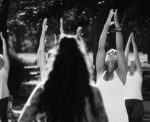
In a vinyasa class, the sequence is used as a warm-up for the body. Sun A’s get your heart pumping and aid in opening up the areas that need a bit of prep to be able to practice more advanced poses. Sometimes referred to as a ‘vinyasa,’ one round of Sun A is used as a transition between poses in a vinyasa-style class.
In Sanskrit, vinyasa means ‘to place in a certain way.’ The prefix ‘vi’ means ‘in a certain way,’ and ‘nyasa’ means ‘to place’. In a vinyasa practice, this refers to the sequence of poses and the transition from one pose to the next.
The poses are traditionally practiced with one movement syncing with one breath. Here’s a tutorial for Sun Salutation A, the cornerstone of a vinyasa yoga practice!
tadasana – mountain pose
- Bring your feet together so that your second toes are parallel – heels slightly parted, base of big toes touching
- Engage your quadriceps so that your kneecaps lift
- Find a slight internal rotation of the thighs
- Turn your palms to face forward, for external rotation of the upper arms, keep your hands active
- Keep your neck long and shoulders down & back
urdhva hastasana – raised hands pose

- Maintaining the alignment of tadasana, on an inhale raise your arms over your head
- Keep your arms and hands active, slightly turning your pinkies toward each other to externally rotate the upper arms
- Draw your shoulders down and lengthen your spine from neck to tailbone
uttanasana – standing forward fold

- On an exhale, hinge from the hips and fold forward. Palms can be together and come down in front of your midline, or you can swan-dive your arms as you fold
- Bend your knees if you have tight hamstrings
- Ground down into your feet and bring your weight further toward the balls of your feet – this will bring your hips over your ankles
- Let the back of your neck be soft
uttanasana tutorial
ardha uttanasana – half forward fold (aka half lift)

- Bring your fingertips or hands to the floor or your shins
- On an inhale, straighten your arms and lengthen your spine forward
- Direct your gaze six inches in front of you, being mindful not to compress the back of your neck
chaturanga dandasana – low plank pose

- On an exhale, plant your hands into the ground and either step back to plank pose, or float your legs back.
- If you are floating your legs back, come directly into chatarunga
- Elbows stacked over wrists and upper arms parallel to torso
- Keep one long line of energy from your heels to the crown of your head
chaturanga tutorial
urdhva mukha svanasana – upward facing dog
- On an inhale, come onto the tops of your feet and let them press down
- Press into the ground and straighten your arms
- Engage your legs so your knees and thighs are lifted off the floor
- Draw your shoulders back, shoulder blades in and toward one another
- Keep the back of your neck long
- Lift through the sternum and broaden across the collarbones
- Isometrically spiral your hands outward to externally rotate your upper arms
up dog tutorial
adho mukha svanasana – downward facing dog

- On an exhale, come back on to the balls of your feet, press your hips up and back
- Hands and feet shoulder width apart, firmly rooted into the ground
- Shoulders away from your ears
- Stay long in the neck
- Press thighs to back of the room, press chest to thighs
down dog tutorial
ardha uttanasana – half forward fold (aka half lift)
- On an inhale, bend your knees. Exhale, step or float your feet to the top of the mat
- On an inhale, straighten your arms and lengthen your spine forward
- Stay long throughout your spine and be careful not to compress your neck
uttanasana – forward fold
- On an exhale, sink back down into a forward fold
- Keep your head heavy and the back of your neck soft
urdhva hastasana – raised hands pose
- On an inhale, come to stand with the arms overhead
- Keep your arms and hands active
- Draw your shoulders down and lengthen your spine from neck to tailbone
tadasana – mountain pose

- As you exhale, bring your hands to heart center palms touching
From here you have options. You can transition into a different pose. Or, you can practice more rounds of Sun A if you want to keep building heat and warming your muscles.
sun salutation b
custom & original yoga sequences designed for you – available to purchase here